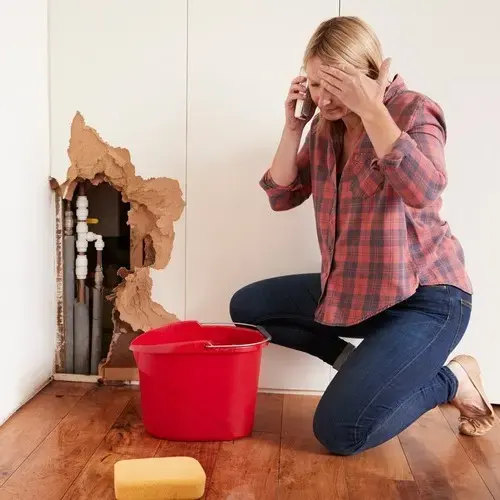
Much of Pico Rivera was built as single-story tract housing from the late 1940s through the early 1960s, and many of those original homes still carry the galvanized steel supply pipe that went in back then. That pipe rarely fails with a bang. It corrodes from the inside, weeps at the threads and soaks a wall cavity for a long time before anyone sees a stain.
Key takeaways
- Galvanized steel supply pipe corrodes from the inside, so the first leak is usually a slow weep at a threaded joint, not a burst.
- Pico Rivera tract homes are built slab on grade with no basements, so leaking water collects in wall cavities and along the slab edge.
- Low water pressure, rusty or brown water and a stain that returns after painting are the signs worth acting on.
- Shut off the main supply once a leak is confirmed, then have the wall moisture mapped before any drywall is cut.
- Drying runs to daily readings until the framing, the slab edge and the drywall all read dry.
Why original galvanized pipe fails from the inside
Galvanized pipe is steel with a zinc coating. When it was installed in the post-war building boom, the coating was meant to keep rust away from the water.
Decades of flowing water wear that coating down, and the steel underneath starts to rust from the inside out. The pipe can look fine on the outside while its bore narrows.
What happens at the threads
Threaded joints are the thinnest part of the pipe wall. They are also where rust builds up first, so that is where pinhole leaks usually start.
A weeping thread does not spray. It seeps, and the seep runs down the pipe and into the bottom of the wall.
Why the failure is slow
Rust can plug a pinhole for a while and then let go again, which makes the leak come and go. That is why a homeowner can chase a stain for months without finding its source.
The slow pace is the danger. Drywall, insulation and the wood plate at the wall base can stay wet the whole time.
Warning signs inside a Pico Rivera tract home
A single-story tract home gives few dramatic clues. The signs are small and easy to blame on something else.
Walk the house once and look for these patterns:
- A brown or rusty tint in the water when a faucet runs after the house has sat unused for a while.
- Water pressure that has dropped over time, especially at fixtures far from the main shutoff.
- A stain, bubble or soft spot on drywall that comes back after it was painted over.
- Baseboards that swell, lift or darken along one wall.
- A musty smell in a closet, hall or bathroom wall with no visible source.
- A water meter that keeps moving when every fixture is off.
What the water does in a slab on grade house
Pico Rivera homes of this era sit on a concrete slab, and none of them has a basement. Water that leaves a pipe inside a wall has nowhere to drain away.
It follows the framing down to the bottom plate, soaks the lower drywall and spreads along the edge of the slab. From there it can wick into baseboards, closet floors and the next room.
A leak in a wall behind a bathroom or kitchen is common because that is where supply branches are concentrated. The wall surface may look dry while the cavity behind it stays wet.
- Bottom of the wall: drywall wicks water upward and softens.
- Insulation: wet insulation holds moisture against the framing and dries slowly.
- Slab edge: concrete takes on water and releases it back into the room for days.
- Flooring: laminate, vinyl and carpet along the wall can cup, lift or stain.
What to do on the first day
The goal on the first day is to stop the water and learn how far it has traveled. Cutting open walls at random just makes the repair larger.
A leak in old supply pipe also tends to get worse once the pressure is turned back up, so the order of the steps matters.
- Shut off the main water supply to the house.
- Open a low faucet to drain the pipes so pressure comes off the leaking joint.
- Take photos of the stain, the baseboard and any rust marks before anything is moved.
- Move furniture and rugs away from the wet wall.
- Call for a moisture map so the wet area is measured instead of guessed.
- Contact a plumber to find and repair the failed pipe.
How the drying team handles a wet wall
The restoration team starts with a thermal scan and a moisture meter to find the edges of the wet area. Where the leak is behind drywall, the wall is opened at the leak and wherever readings stay high.
Wet insulation and soaked drywall come out. Dry materials stay in place so the repair is no bigger than the damage.
Then the structural drying work begins. Air movers push dry air across the opened cavity, an LGR dehumidifier pulls moisture out of the air, and drying mats can pull water out of the slab edge.
The drying team returns to take readings every day. The equipment is only removed once the framing, the slab edge and the drywall all read dry.
When water has already reached the floor
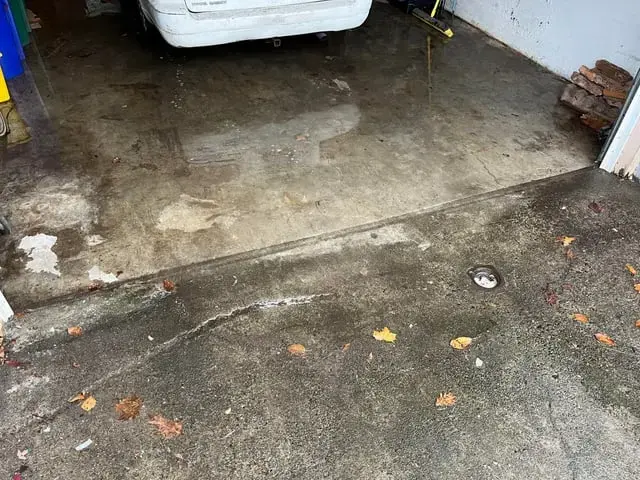
If a weeping thread has finally let go and water is standing on the floor, the first job is removal. Water extraction lifts standing water off the slab, carpet and pad before it wicks farther into the walls.
A crew that handles galvanized pipe leak damage in older homes expects to find that the visible puddle is smaller than the wet area behind it.
Not every leak sits in a wall. A pipe running under the floor causes a different set of signs, and the slab leak warning check is a quick way to see which pattern a home is showing.
Replacing the pipe is a plumber's decision
A restoration crew dries and repairs the damage. It does not decide whether one failed joint or the whole supply system should be replaced.
That decision belongs to a plumber who can see the condition of the pipe. A homeowner can ask what the interior of the removed section looked like, because heavy rust inside is a sign that other joints are close behind.
Drying before the repair is rarely a good plan, since a fresh leak will soak the same wall again. Most homeowners have the plumber fix the pipe first and then let the drying finish.
Insurance coverage for this kind of damage varies by policy, so it helps to confirm terms with the insurer and keep the photos and moisture readings together.